ISSN-E: 3105-7926
ISSN-P: 3105-8817
- info@glopri.com
- Mon - Sat 8:00 - 18:00. Sunday CLOSE
Shabana Yasmeen : (M.Phil. Scholar, Department Of Media & Communication Studies, Faculty Of Social
Sciences, National University of Modern Languages (NUML), Islamabad, Pakistan.)
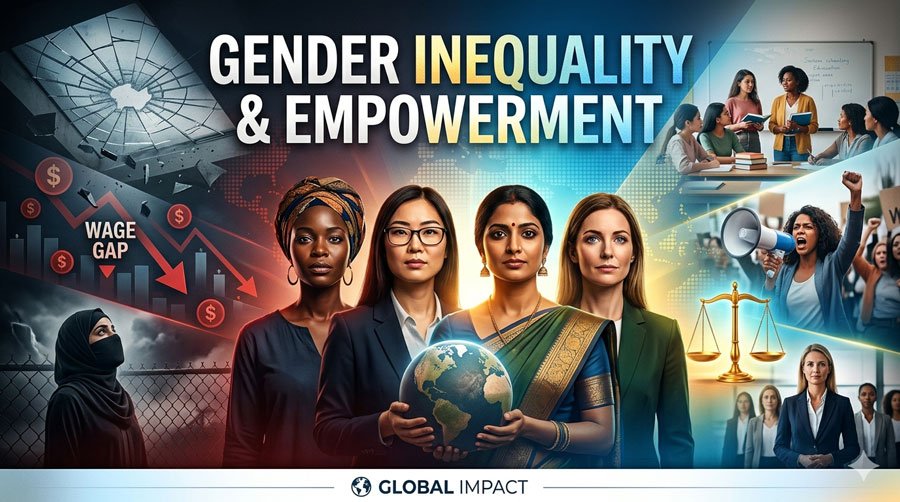
The problem of inequality between genders is an international problem that restricts the rights and opportunities of women. The paper explores the limited opportunities and social barriers, education gaps, job discrimination, and cultural norms, and stresses the policy reform and international actions to ensure equality and development.
The issue of women's rights is one of the greatest concerns in the world,
which has impacted millions of women in both developed and developing nations. Women tend to experience gender inequality, unequal wages, inadequate access to education and health, and a lack of representation in leadership positions around the globe. The freedom and opportunities of women are limited in most
areas by cultural and social norms. Critical problems like gender-based violence, workplace harassment, child marriage, and a deficiency of legal protection remain a global problem. These issues restrict the full involvement of women in society and their potential. Gender equality is being facilitated by international entities such as the United Nations via various activities, such as the Sustainable Development Goals (SDGs) and Goal 5: Gender Equality. Securing the rights of women in any country is critical to social justice, economic growth, and universal development. Gender inequality is one of the challenges that has been persistent in the world since women have been affected in nearly every part of the globe. It can be defined as the unequal treatment, position, and opportunities accorded to people based on their gender, with women frequently being at the short end of the stick as compared to men. Although in most countries the situation has improved, there remain major discrepancies between women regarding their access to education, employment, health, and decision-making. Not only do these inequalities limit individual potential, but they also retard the general social and economic development.
Access to limited opportunities is one of the key factors of gender inequality. Poverty, cultural beliefs, or the absence of resources in most parts of the world mean that girls will not be given quality education. Even educated women tend to be discriminated against in the labor market, such as being paid less than men to do the same work, being denied promotion opportunities, and being poorly represented in positions of leadership. This forms a cycle wherein women cannot maximally contribute to economic growth, and this supports inequalities.
The existence of social barriers based on cultural norms and traditional gender roles is another important factor. Women in most societies are supposed to be more concerned with home tasks rather than education or even professions. These anticipations limit their autonomy and authority to make decisions. These
limitations are further reinforced through stereotypes, like considering men as
leaders and women as caregivers. Consequently, women can be less confident and have fewer opportunities and resources in comparison with men.
Also, gender inequality is intertwined with other problems like gender-based violence, harassment, and child marriage, which have been haunting millions of women all over the world. Not only do these issues infringe on basic human rights, but they also deny women the chance to be fully involved in society. There are legal protections in most countries, but they are not effective due to the fact that they are not implemented effectively, and the people are not aware of them.
International agencies such as the United Nations have been able to appreciate the importance of gender equality as a basic human right and a major contributor to sustainable development. With programs like the Sustainable Development Goals (SDGs), especially Goal 5 (Gender Equality), attempts are being undertaken to eradicate discrimination, empower women, and give them equal opportunities. There is also an awareness-raising, policy-enhancing, and inclusivity-making effort by the governments, NGOs, and communities.
To sum up, gender inequality, lack of opportunities, and social restrictions
remain and will be the obstacles to the advancement of women globally. These
problems cannot be solved alone, but with the help of policy reforms, education, and cultural change. Gender equality is not only good for women but also helps in the enhancement of the economy, health, and a fairer and more balanced world.
The term a major topic in global human rights discourses is used to talk about
questions that are generally considered to be significant in the defense of basic
human rights and the dignity of individuals all over the world. Governments,
policymakers, researchers, and international organizations often discuss these issues since they involve large populations of people and have long-term
social, economic, and political implications. Gender inequality is one of such significant problems; it still poses a challenge to the concept of equal rights and opportunities for all people, irrespective of gender.
Human rights constitute basic freedoms that every individual is supposed to enjoy, such as the right to education, work, security, and equal treatment by the law. By making an issue a part of global human rights discourse, one can say that it is not restricted to a specific country or region but is a common problem that demands international participation and collaboration. Gender inequality, as an example, is manifested in several ways all over the world, such as inequality in
salaries, access to leadership positions, and social limitations on the independence of women. These issues are a direct contravention of the rule of equality and fairness.
International bodies such as the United Nations are very important in terms of bringing to the fore and solving such problems. They develop international structures, treaties, and objectives to make nations act. As an example, gender equality is one of the Sustainable Development Goals (SDGs), which highlights its role in the advancement of the global community. These are even done to make sure that everyone, irrespective of gender, is given equal chances to succeed and be productive members of society.
In addition, it is better to discuss those problems on the global level and raise awareness and urge countries to change their laws and policies. It also enables the sharing of ideas, solutions, and best practices between nations. Nongovernmental organizations and activists also play a role in enforcing a change and holding authorities responsible.
To sum up, as one of the key issues of the global human rights discourse, the issue is well-known as a problem that requires the realization of justice, equality, and human dignity. It involves combining the efforts of governments, organizations, and individuals across the globe to tackle such issues. The international community is addressing these issues to create a more equitable, inclusive, and sustainable future for all.
References